
Looklabcase studyvalidated prototype
LookLab
Designing the fashion trends feature for an early-stage sourcing platform — from user research through developer handoff.
Overview
For my Master’s capstone my team and I worked with a fashion education nonprofit to design Looklab, a platform that helps independent fashion retailers make better sourcing and buying decisions and connect with emerging fashion designers. Over a 6 month period, I was responsible for leading the end-to-end design of the fashion trends feature and conducting user research alongside my teammates to better understand how independent fashion retailers source inventory.
By the end of the project, our client — who came to us with an early concept and no existing product — had a complete, developer-ready prototype spanning 6 core features. This gave the client a concrete artifact to take into fundraising and development conversations, rather than an idea alone.
Context
Trends drive a large share of fashion buying, but retailers have no reliable way to judge whether a given trend is worth investing in, or where to source the inventory to act on it. The trends feature grounds each trend in the cultural conversation that produced it, giving retailers a basis for judging whether it fits their store and a path to sourcing it if it does.
My role included the entire design process: speaking to independent retailers and learning about their sourcing process, creating concepts and wireframes, contributing to the design system, refining the flow, designing the final UI, conducting usability testing, implementing iterations, and preparing the file for developer handoff.
Constraints
Limited exposure to target users
Since we weren't able to recruit enough retailers, we relied on accounts from corporate fashion buyers to supplement our understanding of retailers' decision-making process around sourcing inventory and evaluating trends.
Limited trend data availability
It cannot be denied that data breathes life into trend analysis; however, without a data scientist on the team, we had no way to assess which data sources would be technically or financially viable to integrate post-handoff. This shaped my approach to designing the trends feature — I grounded it in the qualitative factors retailers and fashion forecasters already use to evaluate trends. Quantitative data is still essential, but its integration should happen thoughtfully in future iterations.
Research
Research goals
My team and I interviewed independent retailers and buyers to understand how they factor trends into sourcing, and how they balance fast-moving trends against their brand identity. I also reviewed trend-forecasting literature to ensure the feature's logic aligns with how fashion professionals think about trends.
Key findings
Independent retailers are cautious about following trends. Instead, they rely on close, first-hand customer relationships and intuition to guide trend evaluation and adoption.
“I think trends come and go. I think brands are who they are and I think that if you are authentic and there's a uniqueness to what it is that you're doing, then you'll attract the customer. Being on trend is just a slippery slope.”
— independent retailer
Because retailers already approach trends with skepticism, I designed the trends feature to educate them about current trends rather than push them toward adoption.
Retailers also look beyond fashion itself to anticipate emerging trends. When I asked a retailer how they stay informed on current fashion trends, they suggested looking elsewhere entirely.
“Look into other industries and what's going on in the world. Politics, AI, sustainability, real estate…they all contribute to the fashion scene.”
— independent retailer
This approach reflects how fashion trend forecasters predict emerging trends: they examine the economy, politics, and cultural shifts to anticipate what's next. This informed my decision to connect fashion trends to the cultural elements driving them.
Design decision
I explored three ways to structure a trend.
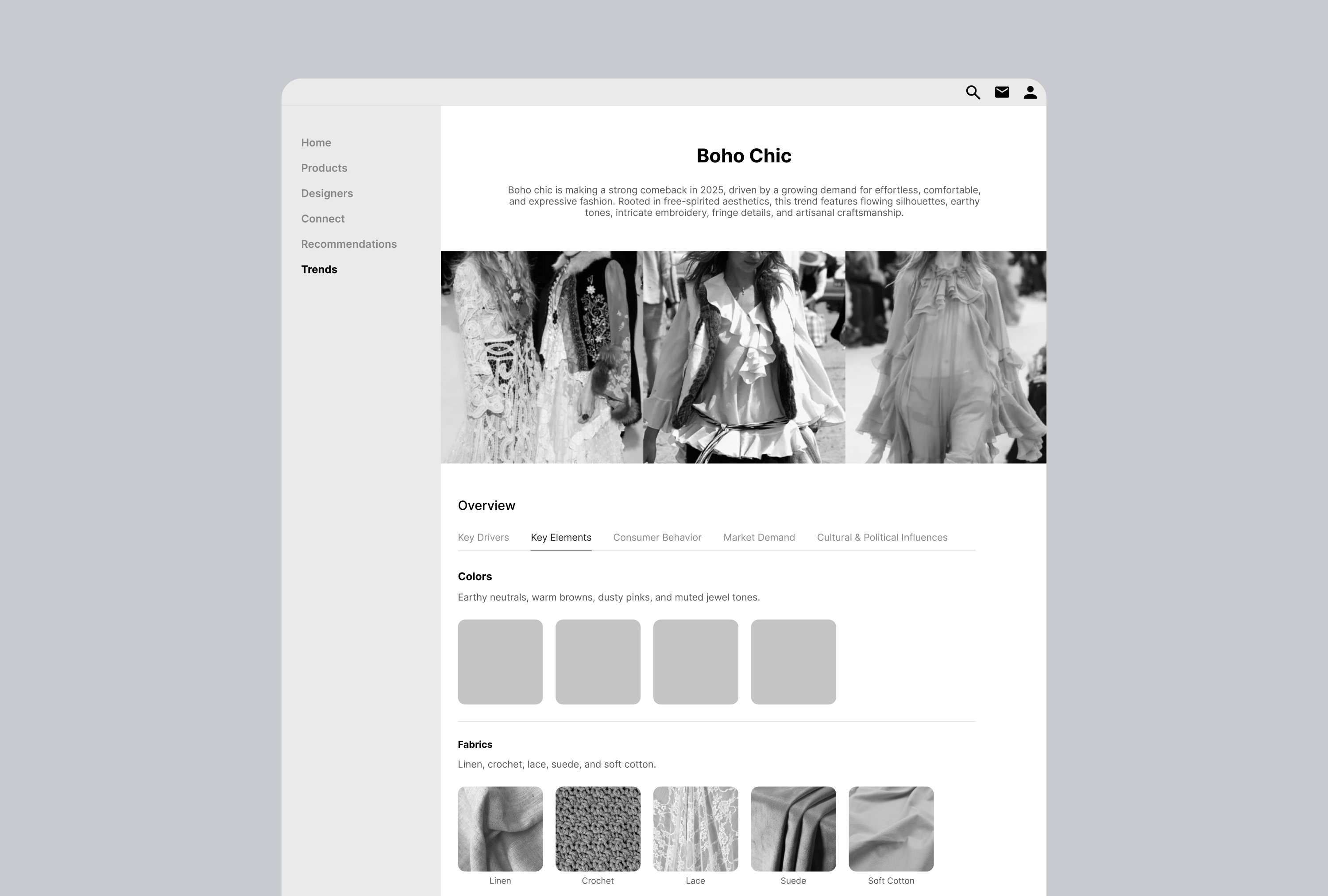
Concept 1: quick scan
Broke a trend down into its components (colors, fabrics, etc.) for an efficient scan.
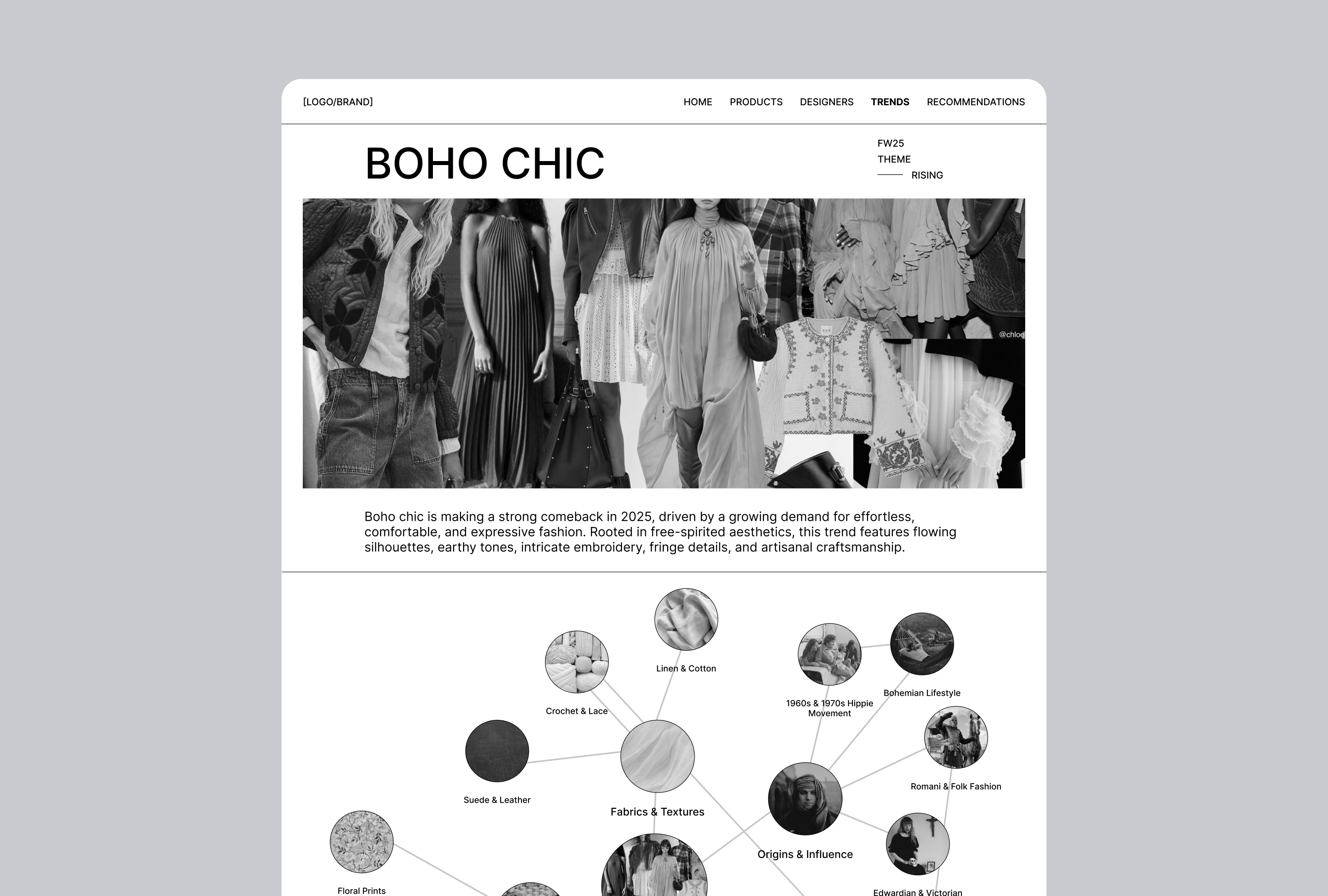
Concept 2: mind map
Kept those same components but arranged them as a mind map, showing how the elements of a trend relate to one another and to the cultural moments they came out of.
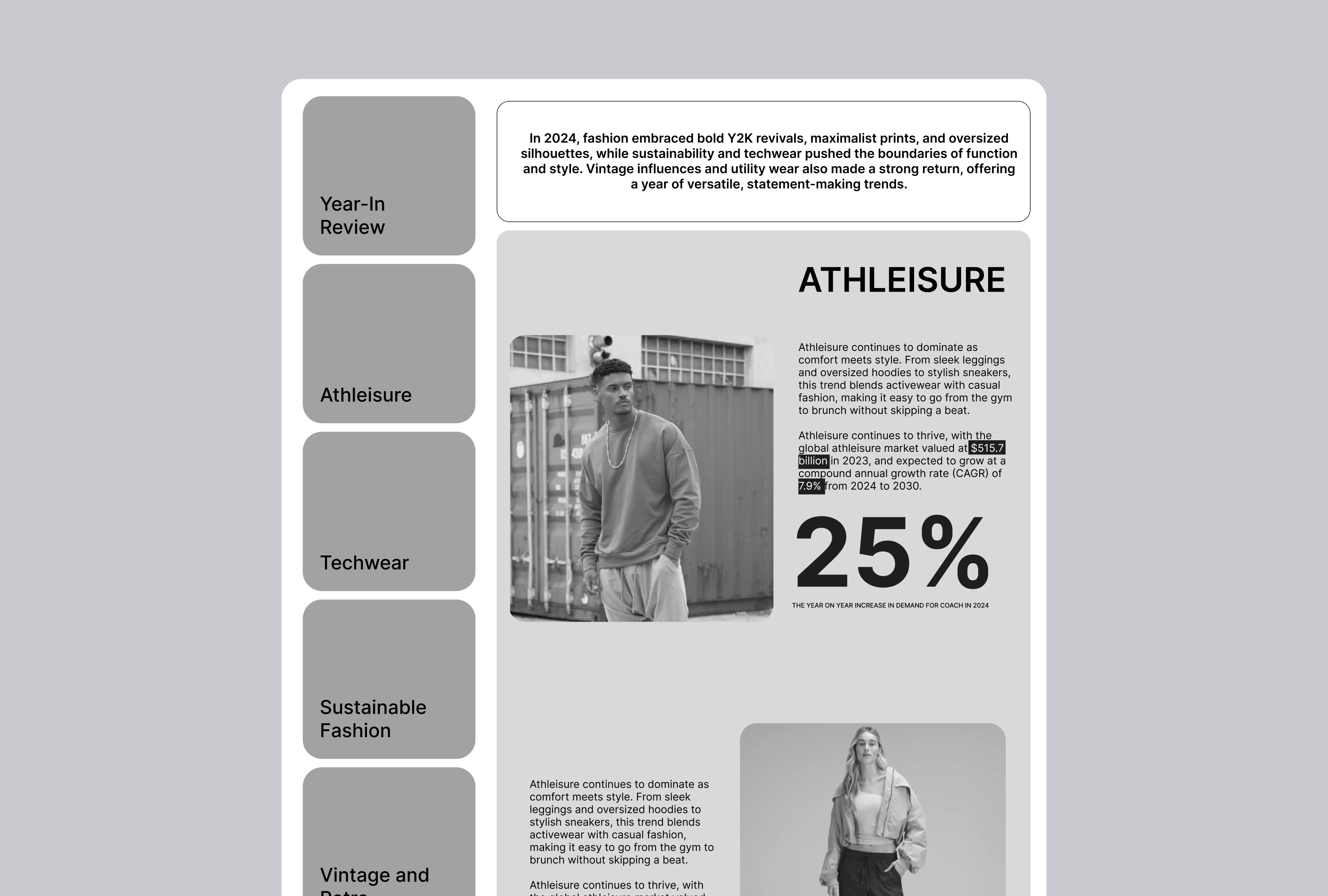
Concept 3: season report
Functioned like a magazine spread, featuring a season-wide report covering every major trend at once.
I advocated for concept 2. During research, I learned that retailers value understanding how fashion trends reflect cultural conversations. While concept 1 shows retailers that the trend boho chic consists of crochet and earth-tone elements, it fails to show that the trend traces back to 1970s counterculture and a renewed appetite for artisanal craft. The mind map fills that gap by showing how trend elements relate to each other, aligning with how retailers evaluate a trend's cultural significance.
Concept 1's strength was scanability, so choosing concept 2 meant trading speed for depth. That trade held up because sourcing isn't a glance-and-go decision — independent retailers buy on small budgets with very little room to experiment, so I designed for a retailer weighing whether to buy into a trend.
Concept 3 let retailers take in the entire season at once and see how trends sit relative to one another, which concept 2 fell short on. I addressed this through the information architecture instead: a landing page opens the feature with every trend of the season, flagged as emerging or declining, and the retailer chooses which one to open.
The mind map also gives the feature a path back into the rest of the product. Each node is clickable, so a retailer curious about one element can open it, read further, and source items tied to it — leading into the platform's core action of connecting retailers with emerging designers and products.
After discussing this with my team and client, we chose to pursue concept 2.
Usability testing
Goals
Since credibility is what makes or breaks a feature for skeptical retailers, I tested whether the trend insights felt trustworthy, clear, and useful for buying decisions, and used what I learned to shape the next iteration.
Method
6 moderated remote sessions, 30 minutes each (4 independent retailers, 2 corporate buyers), with a clickable prototype. Each participant explored the Boho Chic trend, dug into its fabrics and textures, and thought aloud while navigating. Participants rated helpfulness and trustworthiness on a five-point scale.
Findings
Iterations
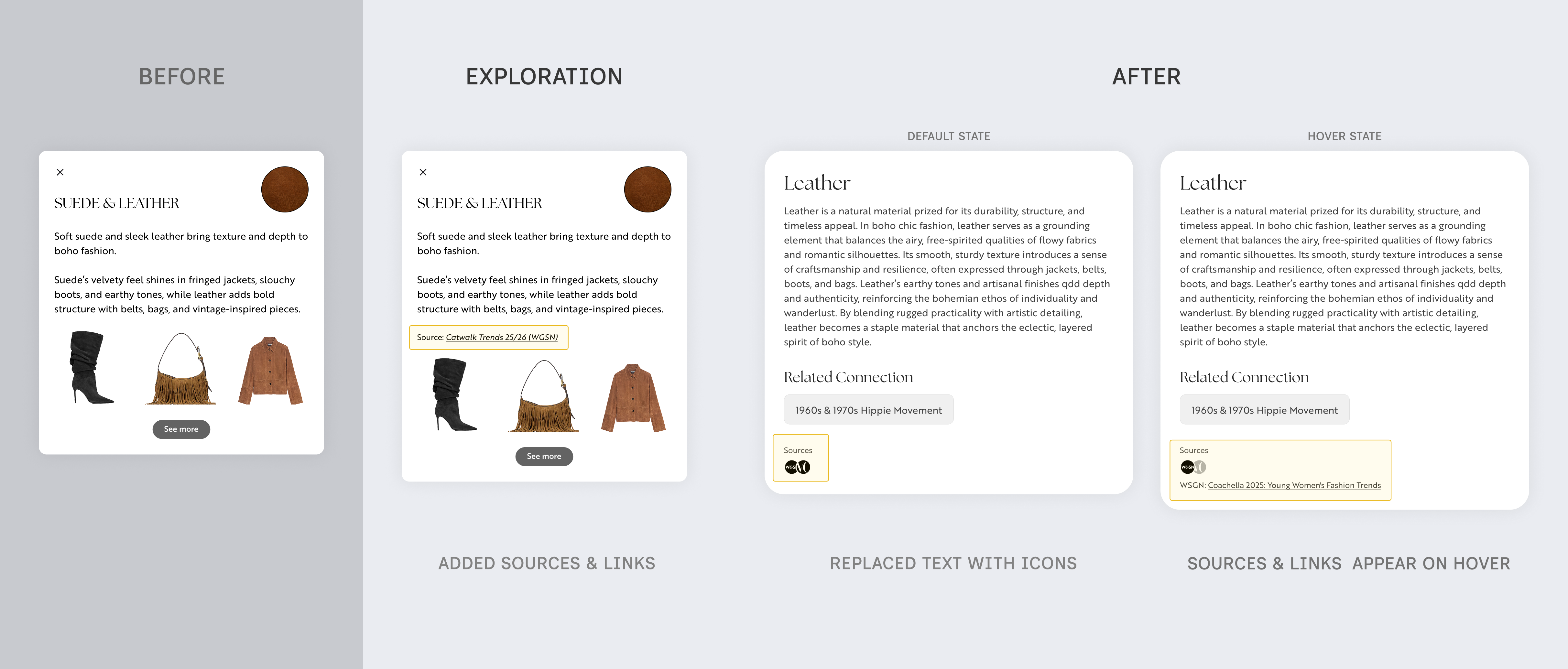
Establishing trust & credibility
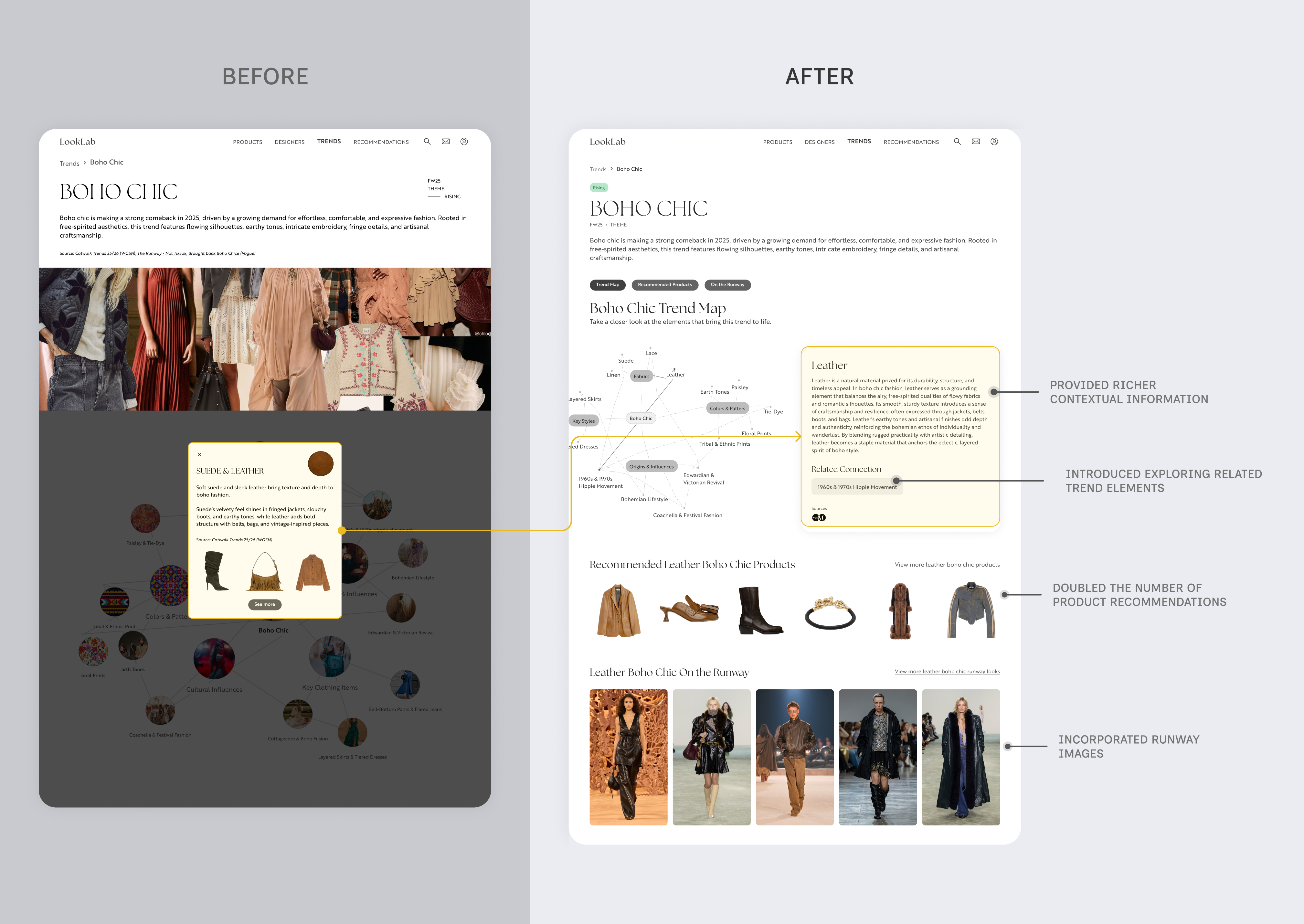
Low trust scores came from participants not knowing where the trend information came from. I initially omitted citations because I assumed users would trust the platform to handle data validity in the background. This feedback highlighted that transparency is a key trust factor, so my iteration focused on including references to data sources to build trust.
Enhancing discovery
Low helpfulness scores traced back to retailers wanting more examples of how a trend can be applied — storefront merchandising, for instance. I addressed this by adding runway imagery, contextual information, and expanded product recommendations, so a retailer can see how established designers have interpreted a trend and quickly judge whether it fits their brand and their customers.
Outcome
Our client came to us with an idea, and we designed a high-fidelity clickable prototype with handoff notes that is ready for development. Our client is currently recruiting developers — the product has not shipped yet.
Reflection
I built this feature to help retailers understand fashion trends. What I missed is that understanding isn't the same as knowing what to do with it. Retailers were able to understand the trend boho chic and its influences, but they were still stuck on which pieces to buy. I felt like I completed half of a puzzle. Next time I'd start from the decision a user is trying to make and work backward to the information they need, instead of the other way around.
If I had six more months to work on this project, I would introduce a “smart shopper” feature that scans the retailer's existing inventory, recommends relevant trends, and recommends specific products within a trend that align with their current inventory. This would let them see a trend through the lens of their own store, which is where the decision actually gets made.